
Playing With Fire
By David McCall
USW International President
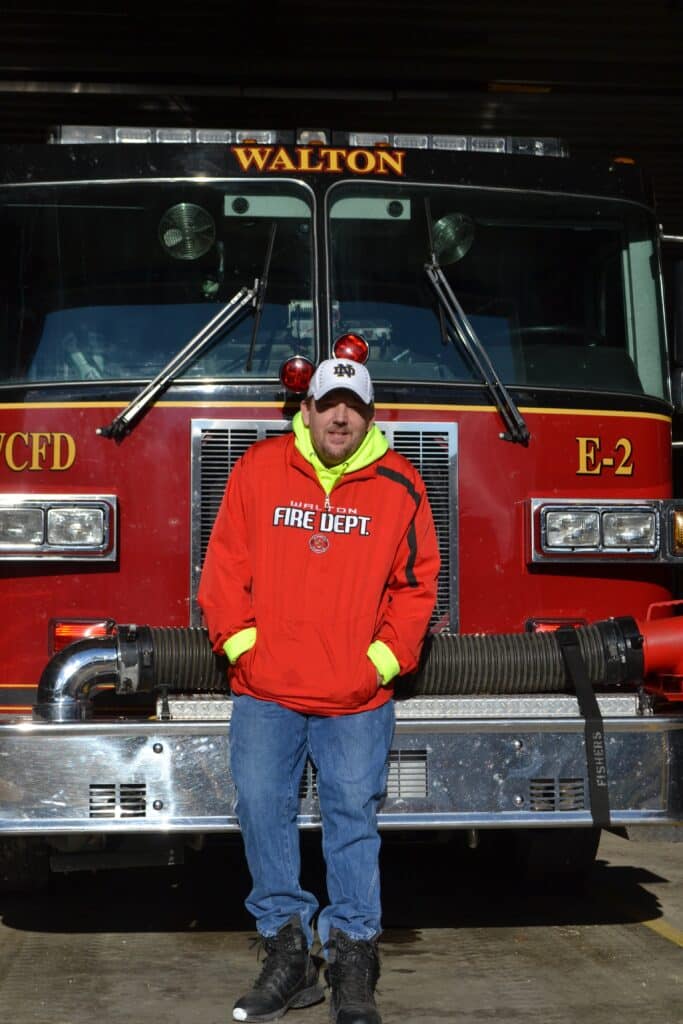
Paul Wines helped to kick in the door of the warehouse and heard a sound like a freight train crashing through town.
A blaze fueled by leather goods and other flammable materials burst through the opening in an instant, momentarily stunning Wines, then on his first big call with the all-volunteer Walton Community Fire Department in north-central Indiana.
Wines owes his life to the self-contained breathing apparatus (SCBA) he wore on that day about 20 years ago. It protected him not only from the smoke and fumes that poured out of the building but from the intense heat that otherwise would have seared his lungs as he took a sharp, startled breath in that fire-engorged doorway.
Tens of millions of Americans—firefighters, hazardous materials crews, members of the armed forces and workers in numerous occupations—rely on the SCBA, respirators and other devices tested and certified by the National Institute for Occupational Safety and Health (NIOSH). Americans depend just as heavily on NIOSH’s research, monitoring and health bulletins.
Yet Donald Trump and congressional Republicans want to gut the agency, putting countless lives at risk.
Trump first tried to sabotage NIOSH’s crucial work with mass layoffs, which prompted a lawsuit in May from the USW and a coalition of allies represented by the AFL-CIO and Public Citizen.
Now, Trump and the Republicans in Congress are taking another approach—attempting to paralyze the agency by decimating the agency’s budget. House Republicans proposed a 15 percent cut while Trump demanded 80 percent.
“You’re playing with fire, literally,” warned Wines, a member of United Steelworkers (USW) Local 2958, who still volunteers as a firefighter and EMT and also uses NIOSH-approved personal protective equipment (PPE) in his job at Haynes International in Kokomo, Ind.
In 1970, Republican President Richard Nixon signed the legislation that created NIOSH to conduct research and make recommendations for averting work-related injuries and sicknesses.
Besides certifying SCBA, respirators and related devices, NIOSH publishes the Pocket Guide to Chemical Hazards, which gives exposure limits, PPE recommendations, first aid information and other guidance for hundreds of chemicals used in workplaces. Workers, the unions representing them, managers and first responders all rely on it.
The agency also advises emergency crews on other important issues, such as decontamination protocols, and it reviews firefighter fatalities for lessons that might help to avert future tragedies.
“We need that data,” said Wines, whose department answers calls at farms, chemical plants, homes and a variety of other sites in the community of about 1,000 people while also assisting fellow firefighters in three neighboring towns.
“We need to know if there’s a better way to do this, a safer way,” he added, noting it would be foolish to squander knowledge to be gained from others’ sacrifices. “Your heart goes out to the ones we lost because they’re saving the ones that are still fighting.”
Some of Wines’ co-workers at Haynes International, a maker of alloys, use NIOSH-approved respirators on the job. And as the leader of the plant’s hazardous materials crew, he uses NIOSH’s Pocket Guide and agency-approved PPE to prepare, train for and respond to workplace incidents.
Yet all of that represents just a fraction of NIOSH’s reach.
The agency studies hazards in mines and tracks the health of coal miners. It works to improve safety in construction and manufacturing environments. It contributes to the training of industrial hygienists, epidemiologists and similar experts.
It helped the nation respond to the COVID-19 pandemic and prepare for other disasters. And its experts have even studied the impact of mold on public health as well as the risks posed by asbestos, lead and other hazards.
“I don’t know where we would be—as a local, as a worksite, at any Department of Energy site—if NIOSH had not been actively involved,” said Herman Potter, former president of USW Local 689.
The members of Local 689 work for a consortium of companies with contracts to clean up the Portsmouth Gaseous Diffusion Plant in Piketon, Ohio, a site that the Department of Energy once used to enrich uranium for the nation’s nuclear energy and national security needs.
These USW members perform dangerous work. Potter, mindful that NIOSH provided expertise as well as leverage, sometimes asked the agency to perform health hazard evaluations of the site and to strategize with him on ways to improve safety.
“This is a way to fight on these issues,” said Potter, who also served as the union safety representative at Portsmouth, noting companies often fear NIOSH because agency experts scrutinize working conditions and then make their findings public.
“What are they going to do about it?” he said, emphasizing that employers have little recourse against well-trained, independent-minded NIOSH investigators. “They can’t fire them.”
The focus on workplace safety and health must be continuous and diligent, adapting to new technology and industries. Gutting NIOSH now potentially exposes workers to cancers and many other diseases that might go unnoticed for years, Potter observed.
Wines and his fellow firefighters put themselves in harm’s way knowing they do all that they can to stay safe.
They train rigorously. Veterans take recruits under wing. Wines and his colleagues carefully test their SCBA and other devices to ensure they function properly.
But Wines considers NIOSH an indispensable partner in these efforts, ensuring that the equipment they stake their lives on is worthy of that trust.
“If it weren’t for NIOSH, we wouldn’t have the reliable and safe gear we do today. We’d be smoke eaters,” with many more firefighters dying, he said.
By clicking Sign Up you're confirming that you agree with our Terms and Conditions.
Ready to make a difference?
Are you and your coworkers ready to negotiate together for bigger paychecks, stronger benefits and better lives?