
‘The Hell with Everyone Else’
By David McCall
USW International President
Al Polk landed a job at a cutting-tool plant in his early 20s and then promptly started paying Social Security taxes—every week, 12 months a year, without a break, for decades.
Polk realized that collective responsibility for Social Security ensured a dignified retirement for all, and he took pride in holding up his end of a sacred compact with millions of fellow Americans.
Now 82, Polk continues to enjoy his golden years because of Social Security and his union-negotiated pension. But he knows that future generations of workers will be forced to scrape by in retirement or toil until they die—unless the wealthy finally begin paying their fair share to Social Security, a lifeline at ever greater risk of insolvency.
“Remove the cap, and you don’t have to worry about it,” observed Polk, a longtime activist with the United Steelworkers (USW) from Mansfield, Mass., noting that more equitable contributions from the uber-rich would end the funding crisis in short order.
“It’s an easy fix,” he added. “It’s not going to hurt anybody.”
The federal government imposes Social Security taxes only on the first $184,500 in wages, no matter how much money a person makes this year. Because of this arbitrary and nonsensical cap, hundreds of the nation’s richest people paid their Social Security taxes within the first few minutes or hours of 2026.
Now, despite the pressing need to shore up the Social Security trust funds, they’re sitting out the rest of the year.
Nothing illustrates this rigged system better than the case of Elon Musk, the richest person in the world, who rakes in so much money at so great a speed that he effectively paid all of his required Social Security taxes by 12:15 a.m. on Jan. 1.
On the other hand, more than 160 million ordinary working people—Americans who perform essential jobs but never come close to pocketing $184,500 a year—will keep contributing to Social Security through Dec. 31.
Working people like Polk, who spent much of his life negotiating contracts for union colleagues and holding employers accountable, understand the power of shared prosperity and a strong middle class.
But the rich have a selfish view. They’re bent on hoarding their wealth, widening the economic inequality that’s already tearing at the nation’s social fabric, and turning America into a land of haves and have-nots.
“The hell with everybody else,” Polk said, summing up the mindset of Musk and others of his ilk, who would rather squander their money on failed rocket launches and other vanity projects than support the common good. “It’s just greed.”
Musk’s companies helped themselves to billions in federal funds over the years, meaning he owes much of his wealth to the ordinary Americans he looks down on.
Musk had the audacity to call Social Security a “Ponzi scheme” and reposted a meme characterizing Americans who rely on federal programs as the “parasite class.” When Donald Trump invited Musk to begin decimating the federal government, he quickly set his sights on the Social Security Administration and moved to cut jobs, disrupt operations and hamstring the agency.
The Democrats in Congress and Sen. Bernie Sanders, an independent from Vermont, tirelessly push legislation that would force the wealthy to do their civic duty and contribute an equitable amount for the common good.
Sadly, Republicans refuse to support these long-overdue changes, even though Social Security enjoys overwhelming, bipartisan support among Americans of all ages and from all parts of the country.
The Bipartisan Policy Center, a nonpartisan think tank in Washington, D.C., released poll results in August showing that Americans want lawmakers from both parties to work together to sustain and strengthen the program.
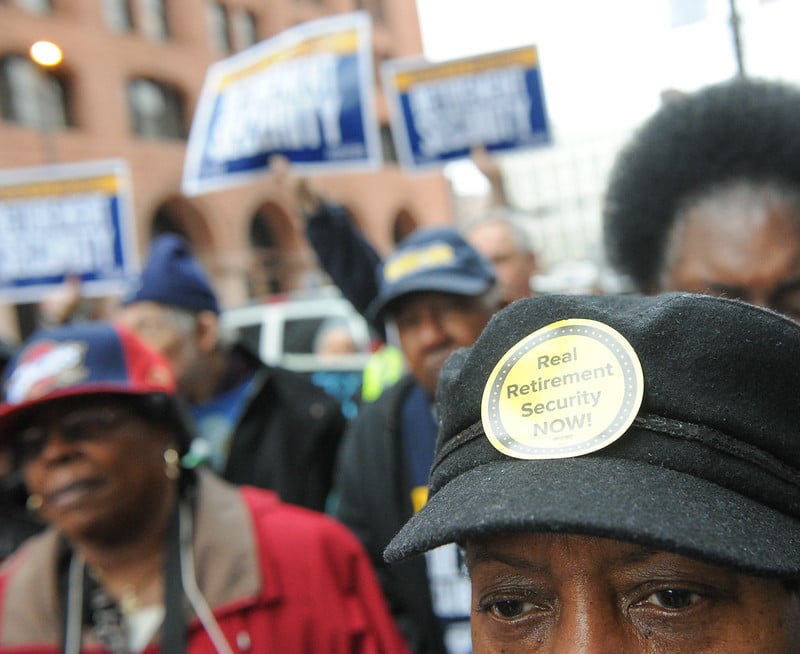
It’s the kind of comment Polk often hears while knocking on doors to promote pro-worker candidates. They tell him they plan to rely on Social Security but at the same time fear its demise.
“It’s the people in the red states that are going to suffer the most,” observed Polk, noting that Social Security’s failure would have a devastating impact on Republican-dominated Southern states with high poverty rates.
And the clock is ticking. Right now, Social Security faces a so-called “go-broke date” in 2034.
That’s when the program will slash benefits to tens of millions of recipients, many of whom barely get by right now. Americans receiving Social Security got only a 2.8 percent cost-of-living adjustment this year, far from enough to cover the spiraling cost of groceries, health care and other essentials in Trump’s inflationary economy.
“It was established with the thought that we would retire in dignity. We’ve been able to do that, but it’s getting harder and harder now,” said Jeff Rains, a longtime USW member who’s now the president of the Steelworkers Organization of Active Retirees (SOAR) chapter in Granite City, Ill.
Instead of working to shore up Social Security to meet retirees’ growing needs, Republicans prefer to talk about raising the retirement age yet again or even “privatizing” the program and putting taxpayer contributions in the hands of Wall Street profiteers.
But all of that represents a betrayal of working people, who willingly do their part for Social Security and demand all that was pledged to them in return.
“It’s not an entitlement program,” emphasized Rains, whose SOAR chapter has circulated petitions, advocated with lawmakers and otherwise fought for Social Security for more than a decade. “We pay into it with every paycheck.”
On Social Security’s 80th anniversary in 2015, Rains and other SOAR members celebrated with a symbolic birthday cake. They also visited the office of U.S. Rep. Mike Bost, a Republican from Illinois, with a demand that he and other lawmakers reinvigorate the program.
They’re still waiting, along with the rest of America.
“The very wealthy people are not paying their share,” Rains said of the obvious path forward. “Scrap the cap.”
By clicking Sign Up you're confirming that you agree with our Terms and Conditions.

Ready to make a difference?
Are you and your coworkers ready to negotiate together for bigger paychecks, stronger benefits and better lives?